Core takeaway
Conclusion: A Secular Song with a Prophetic Soul
Its central claim can be summarized theologically as follows:
> Humanity must not claim the authority to end creation.
In this sense, the song stands as a secular prophecy, condemning a technology that represents not merely political failure, but spiritual catastrophe.
Thus, “Ban the Bomb” stands not merely as protest music, but as a modern echo of patristic prophetic ethics.
Nuclear weapons represent:
Radical negation of communion
Technological domination severed from ascetic restraint
Humanity claiming eschatological power (the power to end history)
Maximus warns against this precisely:
> Evil is not a substance, but a misuse of power contrary to nature
(Ambigua, 42)
1. A case study of Nuclear Deterrence as a Tragic Necessity, by the geopoliticsamongstates.gr
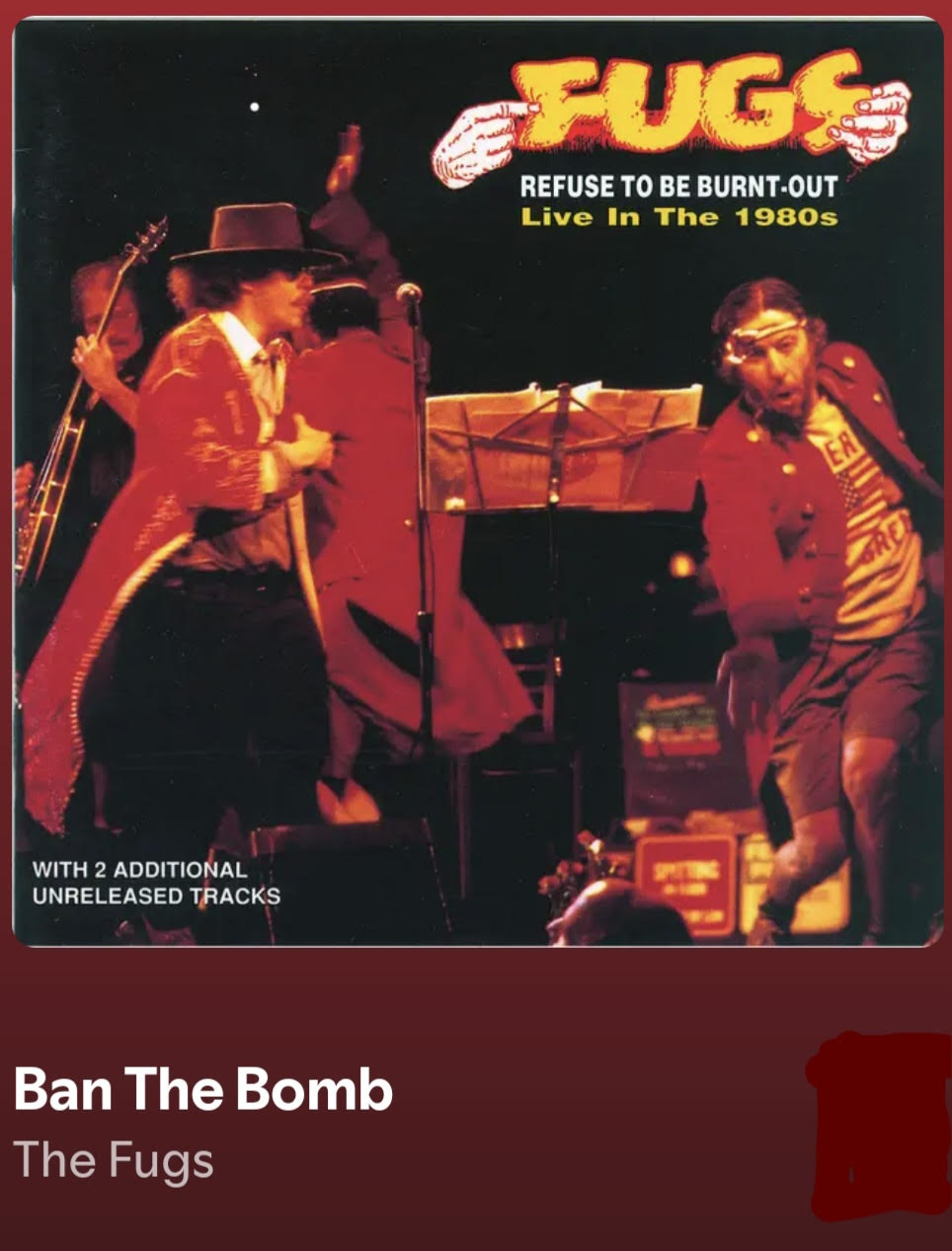
Summary & Interpretation of “Ban the Bomb” – The Fugs
“Ban the Bomb” is a strongly anti-nuclear, anti-war protest song that reflects the radical countercultural spirit of the 1960s peace movement in the United States. The song directly condemns nuclear weapons, portraying them as instruments of mass destruction that threaten humanity rather than protect it.
The lyrics use simple, repetitive, chant-like language, deliberately resembling a protest slogan. This stylistic choice reinforces the song’s function not just as music, but as a political call to action, suitable for demonstrations and collective singing.
The song criticizes:
Governments and military institutions that justify nuclear arms as “deterrence”
The normalization of mass annihilation during the Cold War
The moral hypocrisy of political leaders who speak of peace while preparing for nuclear war
Rather than presenting a complex argument, the song relies on moral clarity and urgency. Nuclear weapons are depicted as inherently evil, irrational, and incompatible with human survival. The repeated demand to “ban the bomb” emphasizes absolute rejection, not regulation or limitation.
Historical & Cultural Context
Written during the Cold War, when fear of nuclear annihilation was widespread
Closely associated with anti–Vietnam War activism
Reflects The Fugs’ blend of satire, anger, irreverence, and moral outrage
Part of a broader artistic movement where music served as direct political resistance
Overall Message
The core message is uncompromising:
Humanity must reject nuclear weapons entirely if it is to survive.
The song rejects technological optimism and military logic, insisting instead on ethical responsibility and collective resistance.
————————–
A structured, academic-style placing “Ban the Bomb” in dialogue with “Kill for Peace” and “CIA Man”, and situating all three within the tradition of protest music.
—
The Fugs and Radical Protest Song:
A Comparative Commentary on “Ban the Bomb,” “Kill for Peace,” and “CIA Man”
1. The Fugs as a Political–Cultural Phenomenon
The Fugs were not merely a musical group but a countercultural intervention. Emerging in the mid-1960s, they combined poetry, satire, folk-rock, and explicit political critique, rejecting both commercial pop conventions and polite liberal dissent. Their work belongs to what might be called confrontational protest music—art designed to unsettle rather than comfort.
Unlike mainstream protest singers, The Fugs deliberately embraced crudeness, irony, and provocation as rhetorical tools. This is crucial for understanding “Ban the Bomb”.
—
2. “Ban the Bomb”: Moral Absolutism and Collective Chant
“Ban the Bomb” represents moral absolutism in protest music.
Key characteristics:
No irony: unlike many Fugs songs, this one is direct and serious.
Repetition: the slogan-like structure mirrors protest chants.
Collective voice: the song speaks not as an individual conscience but as a movement.
Philosophically, the song rejects:
Nuclear deterrence theory
Technocratic justifications for mass destruction
The idea that security can be achieved through fear
The bomb is not portrayed as a political tool, but as a civilizational sin—something incompatible with human continuity. The absence of nuance is intentional: the song insists that some technologies are beyond moral compromise.
—
3. “Kill for Peace”: Irony and the Exposure of Political Language
Where “Ban the Bomb” is absolute and earnest, “Kill for Peace” operates through bitter irony.
Core strategy:
It exposes the linguistic contradiction at the heart of modern warfare
The song mimics official rhetoric to reveal its absurdity
The central critique is not only violence itself, but how language is used to sanitize violence. Governments claim peace, freedom, or stability while engaging in killing. The song suggests that modern power relies on semantic manipulation as much as weapons.
In contrast to “Ban the Bomb”:
The enemy is not a weapon, but ideology
The target is moral self-deception
The tone is mocking rather than solemn
—
4. “CIA Man”: Satire, Paranoia, and Systemic Critique
“CIA Man” takes yet another approach: satirical caricature.
The song:
Presents intelligence agencies as omnipresent and absurdly powerful
Reflects Cold War paranoia, but also critiques it
Blurs the line between conspiracy and reality
Unlike “Ban the Bomb”, which addresses humanity as a whole, “CIA Man” focuses on institutional secrecy and unaccountable power. The song implies that modern citizens live within systems they cannot see or control.
Its humor is strategic:
Laughter becomes resistance
Ridicule undermines authority
Absurdity exposes domination
—
5. Comparative Overview
Song Main Target Rhetorical Method Emotional Tone
Ban the Bomb Nuclear weapons Moral absolutism Urgent, serious
Kill for Peace War ideology Irony & contradiction Bitter, satirical
CIA Man Secret power Parody & exaggeration Mocking, playful
Together, these songs form a triptych of protest:
Ethical condemnation (Ban the Bomb)
Linguistic deconstruction (Kill for Peace)
Institutional satire (CIA Man)
—
6. Place in the History of Protest Music
The Fugs differ from:
Bob Dylan (symbolic, poetic ambiguity)
Joan Baez (moral witness)
Pete Seeger (communal folk tradition)
Instead, they anticipate later movements:
Punk’s confrontational politics
Spoken-word activism
Radical performance art
Their music assumes that shock, humor, and offense can be legitimate tools of moral awakening.
—
7. Concluding Interpretation
“Ban the Bomb” stands as one of the clearest expressions of ethical refusal in protest music. When read alongside “Kill for Peace” and “CIA Man”, it becomes part of a broader critique of:
Militarism
Political language
Invisible systems of power
The Fugs argue—implicitly but forcefully—that modern violence survives not only through weapons, but through words, institutions, and cultural normalization.
—
A Theological–Ethical Reading of “Ban the Bomb” (The Fugs)
1. Introduction: Nuclear Weapons as a Moral Absolute
“Ban the Bomb” can be read not merely as a political protest song, but as a moral indictment of modernity itself. From a theological–ethical perspective, the song implicitly advances a claim that is absolute rather than prudential: nuclear weapons are not simply dangerous or excessive; they are intrinsically immoral.
This places the song in tension with much Cold War political theology, which often attempted to justify nuclear deterrence as a tragic necessity. The Fugs reject this logic entirely.
—
2. Nuclear Weapons and the Breakdown of Just War Theory
Within Christian ethics, the traditional framework for evaluating war is Just War theory (Augustine, Aquinas).
Key criteria include:
Discrimination (non-combatant immunity)
Proportionality
Legitimate defense
Nuclear weapons fail all three:
1. No discrimination
Nuclear weapons cannot distinguish between combatants and civilians. Their effects are inherently indiscriminate—immediate and generational.
2. No proportionality
The scale of destruction exceeds any conceivable political or military objective.
3. No true defense
Deterrence relies on the threat of immoral action. In Christian ethics, threatening intrinsic evil is itself morally corrupting.
“Ban the Bomb” implicitly assumes this collapse: it does not argue for better control or limited use, because no morally licit use exists.
—
3. Deterrence as a Form of Moral Schizophrenia
The Cold War doctrine of Mutually Assured Destruction (MAD) rests on a paradox: peace is preserved by the readiness to annihilate.
From a theological standpoint, this produces:
Divided moral consciousness
Institutionalized hypocrisy
Normalization of apocalyptic violence
The song’s blunt insistence on abolition rejects this paradox. It refuses what theologians like Jacques Ellul and Stanley Hauerwas later criticized as the sacralization of state violence.
The Fugs’ position aligns with a prophetic rather than a realist ethic:
> Some actions are forbidden, regardless of consequences.
—
4. Apocalyptic Power Without Eschatological Hope
Christian eschatology speaks of the end of the world as God’s act, not humanity’s.
Nuclear weapons invert this:
Humanity claims the power of total annihilation
Apocalypse becomes technological, not divine
Judgment is automated, not moral
“Ban the Bomb” implicitly protests this theological usurpation. The bomb is not just a weapon; it is a false god, demanding trust, sacrifice, and obedience in the name of security.
This resonates with biblical critiques of idolatry:
Trust placed in chariots and horses (Psalm 20:7)
Salvation sought through power rather than justice
—
5. Prophetic Ethics and the Language of Refusal
The song’s rhetorical simplicity mirrors biblical prophetic speech:
No nuance
No compromise
No strategic ambiguity
Like the prophets of Israel, it does not negotiate with power; it denounces it.
This aligns the song with:
Christian pacifist traditions
The Barmen Declaration logic (“We reject the false doctrine that…”)
Later ecclesial statements condemning nuclear weapons as immoral per se
The chant-like structure reinforces its liturgical quality: it functions almost as a secular lament or anathema.
—
6. Contrast with “Kill for Peace” and “CIA Man”
From a theological angle:
“Kill for Peace” critiques the language of sin
“CIA Man” critiques the structures of sin
“Ban the Bomb” names a material embodiment of sin
In theological terms, the bomb becomes a concentration of structural evil—a single object that reveals the moral disorder of the entire system.
—
7. Conclusion: A Secular Song with a Prophetic Soul
Although written outside explicit religious language, “Ban the Bomb” articulates a position remarkably close to:
Christian absolute prohibitions
Prophetic moral witness
Eschatological humility
Its central claim can be summarized theologically as follows:
> Humanity must not claim the authority to end creation.
In this sense, the song stands as a secular prophecy, condemning a technology that represents not merely political failure, but spiritual catastrophe.
——————————-
Patristic Foundations for a Theological–Ethical Reading of “Ban the Bomb”
1. Framing the Question Patristically
Although “Ban the Bomb” is a secular protest song, its moral intuition corresponds closely to patristic moral realism: the conviction that certain acts are incompatible with the order of creation, regardless of political necessity.
The Fathers do not speak of nuclear weapons, but they do speak extensively about:
indiscriminate killing,
the moral corruption of violence,
the illusion of security through power,
humanity’s improper claim to divine prerogatives.
—
2. St Augustine: Just War, Intention, and Moral Limits
2.1 Augustine’s Conditional Acceptance of War
St Augustine never glorifies war. For him, war is at best a tragic concession to a fallen world.
Key texts:
Contra Faustum Manichaeum, XXII, 74
De Civitate Dei, XIX, 7
Augustine insists that:
War is justified only to restrain evil
The intention (intentio) must be love of peace (tranquillitas ordinis)
Violence must never exceed moral necessity
> “The desire for harming, the cruelty of revenge, the lust of domination… these are rightly condemned in war.”
(De Civitate Dei, XIX, 7)
2.2 Why Nuclear Weapons Break Augustine’s Framework
From an Augustinian perspective, nuclear weapons are morally incoherent because:
1. Intention is corrupted
Deterrence requires the willingness to annihilate cities. The intentio is inseparable from mass killing.
2. No restoration of order is possible
Augustine’s peace is ordered harmony. Nuclear war produces irreversible chaos.
3. Means overwhelm ends
Augustine never permits evil means for good ends.
Thus, “Ban the Bomb” aligns with Augustine’s deeper logic, even against later “realist” interpretations of Just War.
—
3. St Basil the Great: Violence, Pollution, and Moral Injury
3.1 Basil’s Radical Moral Sobriety
St Basil is far more restrictive than Augustine regarding killing.
Key text:
Canon 13, Epistula Canonica I (Letter 188)
> “Our Fathers did not consider killings committed in war as murder, but they nevertheless required those who killed to abstain from communion for three years.”
This is crucial:
Even “justified” killing causes spiritual pollution
Violence wounds the soul of the killer
War is never morally neutral
3.2 Implications for Nuclear Weapons
From Basil’s perspective:
Killing even one person damages the soul
Nuclear weapons institutionalize mass spiritual destruction
The scale eliminates any possibility of repentance, healing, or ascetic restoration
“Ban the Bomb” echoes Basil’s insight: some forms of violence are so vast that they destroy not only bodies, but moral accountability itself.
—
4. St Maximus the Confessor: Logoi, Creation, and Cosmic Disorder
4.1 The Logoi of Creation
St Maximus teaches that all created beings possess a logos—a divine intention that orders them toward communion with God.
Key texts:
Ambigua 7
Quaestiones ad Thalassium 60
Sin is not merely disobedience but distortion of the logoi.
4.2 Nuclear Weapons as Anti-Logos Technology
From a Maximian ontology:
Creation is oriented toward deification (θέωσις)
Human freedom must cooperate with divine purpose
Nuclear weapons represent:
Radical negation of communion
Technological domination severed from ascetic restraint
Humanity claiming eschatological power (the power to end history)
Maximus warns against this precisely:
> Evil is not a substance, but a misuse of power contrary to nature
(Ambigua, 42)
The bomb is thus not only immoral but ontologically perverse—a tool designed to undo the coherence of creation itself.
—
5. Patristic Synthesis: Why “Ban the Bomb” Is a Prophetic Claim
Bringing the Fathers together:
Father Key Insight Application to Nuclear Weapons
Augustine War only as tragic restraint Nuclear deterrence corrupts intention
Basil Killing wounds the soul Mass killing annihilates moral repair
Maximus Creation ordered to communion Nuclear weapons negate creation’s logos
The song’s demand is therefore not sentimental, but ontologically and morally rigorous.
—
6. Prophetic Refusal and Patristic Ethics
The Fathers share a common refusal:
No salvation through violence
No peace through terror
No authority to destroy creation
In this light, “Ban the Bomb” functions as a secular articulation of patristic moral intuition.
It proclaims—without theological language—the same truth articulated by the Fathers:
> Humanity is not permitted to secure itself by violating the order of creation.
—
7. Concluding Theological Thesis
With explicit patristic grounding, the song’s moral claim may be summarized as follows:
> Nuclear weapons represent an absolute moral boundary, because they unite unjust intention (Augustine), irreversible spiritual injury (Basil), and ontological rebellion against creation (Maximus).
Thus, “Ban the Bomb” stands not merely as protest music, but as a modern echo of patristic prophetic ethics.
_______________________
“Ban the Bomb” and the Patristic Ethics of Absolute Moral Limits
A Theological–Ethical Reading through Augustine, Basil the Great, and Maximus the Confessor
—
Abstract
This article offers a theological–ethical interpretation of the protest song “Ban the Bomb” by The Fugs, situating its moral absolutism within the framework of patristic Christian ethics. Drawing on St Augustine’s theory of just war and intention, St Basil the Great’s penitential treatment of killing in warfare, and St Maximus the Confessor’s ontology of creation and the logoi, the paper argues that nuclear weapons represent an absolute moral rupture rather than a prudential ethical dilemma. Although the song emerges from a secular countercultural context, it articulates a position strikingly consonant with the patristic conviction that certain forms of violence are incompatible with the created order itself.
—
1. Introduction: Protest Song as Moral Discourse
Protest music has often functioned as an alternative form of moral reasoning, translating ethical judgments into accessible and collective language. The 1960s American counterculture produced a particularly uncompromising strand of protest music, one that rejected not only specific wars but the conceptual frameworks that justified them. Among such expressions, “Ban the Bomb” by The Fugs stands out for its refusal of nuance, compromise, or strategic calculation.
Rather than advocating arms control or gradual disarmament, the song articulates an absolute moral prohibition. This posture places it in tension with dominant Cold War ethical paradigms, especially nuclear deterrence theory. This article argues that such absolutism, far from being naïve, finds deep resonance in patristic Christian moral theology, where limits to legitimate violence are grounded not in political realism but in ontology, anthropology, and eschatology.
—
2. Nuclear Weapons and the Collapse of Just War Reasoning
2.1 Augustine on War, Intention, and Peace
St Augustine of Hippo is frequently invoked as the originator of Western just war theory. Yet Augustine’s writings consistently portray war as a tragic concession to sin, never as a positive good. In De Civitate Dei, he insists that even justified wars are morally dangerous, because they risk deforming intention and desire.¹
For Augustine, the decisive moral criterion is intentio: the aim of restoring peace understood as tranquillitas ordinis, the rightly ordered harmony of creation.² Violence motivated by domination, cruelty, or fear is therefore condemned even when politically successful.³
Nuclear deterrence collapses this framework. It depends upon the credible intention to annihilate entire populations, an intention that cannot be disentangled from the act itself. The bomb thus destroys the moral distinction between intention and execution upon which Augustine’s limited toleration of war depends.
—
3. St Basil the Great: Killing, Penitence, and Moral Injury
3.1 War as Spiritual Wounding
St Basil the Great offers a more austere assessment of violence. In his Canonical Epistles, Basil states that soldiers who kill in war are not treated as murderers, yet they must abstain from communion for three years.⁴ This requirement reveals a crucial patristic intuition: even killing deemed socially necessary inflicts spiritual damage.
Violence is never morally neutral. It contaminates the soul and requires healing through repentance and time. Basil thus refuses the idea that war can be fully justified; at best, it can be forgiven.
3.2 Nuclear Weapons and the Erasure of Repentance
From Basil’s perspective, nuclear weapons represent a qualitative rupture. The scale and indiscriminate nature of nuclear violence eliminate the conditions under which repentance, restoration, or moral accountability remain meaningful. The bomb institutionalizes violence beyond penitential repair.
The categorical rejection voiced in “Ban the Bomb” mirrors Basil’s logic: some acts are not merely sinful but destructive of the moral order that makes repentance possible.
—
4. St Maximus the Confessor: Creation, Logoi, and Ontological Disorder
4.1 The Logoi of Creation
St Maximus the Confessor situates ethics within a profound metaphysical vision. Every created being possesses a logos, a divine intention orienting it toward communion with God.⁵ Sin, for Maximus, is not merely legal transgression but a distortion of being itself.⁶
Human freedom is meant to cooperate synergistically with these logoi, guiding creation toward deification (θέωσις).
4.2 Nuclear Weapons as Anti-Logos Technology
Nuclear weapons radically contradict this vision. They are technologies designed not to transform or heal creation, but to erase it. In Maximian terms, they represent power exercised para physin—contrary to nature.⁷
By granting humanity the technical capacity to end history, nuclear weapons constitute an implicit usurpation of divine prerogative. Apocalypse becomes mechanical rather than eschatological. The rejection articulated in “Ban the Bomb” thus resonates with Maximus’s insistence that misuse of power against creation is ontologically evil, regardless of political justification.
—
5. Synthesis: Patristic Ethics and Moral Absolutes
When read together, Augustine, Basil, and Maximus articulate a coherent moral horizon:
Augustine exposes the corruption of intention inherent in deterrence.
Basil reveals the inescapable spiritual injury caused by killing.
Maximus identifies violence against creation as an ontological rebellion.
Within this horizon, nuclear weapons cannot be morally regulated; they must be categorically rejected. The absolutism of “Ban the Bomb” is therefore not simplistic but profoundly consonant with patristic ethics.
—
6. Conclusion: A Secular Song with a Patristic Soul
Although composed within a secular and countercultural milieu, “Ban the Bomb” articulates a moral judgment deeply aligned with Christian patristic theology. It insists that humanity must not claim the authority to destroy creation in the name of security.
In this sense, the song functions as a form of secular prophecy, echoing the patristic conviction that peace cannot be built upon terror, nor salvation upon annihilation. Its demand is not political expediency but moral clarity: there are limits beyond which power becomes sin.
—
Footnotes (Chicago Notes Style)
1. Augustine, De Civitate Dei, XIX.7.
2. Augustine, De Civitate Dei, XIX.13.
3. Augustine, Contra Faustum Manichaeum, XXII.74.
4. Basil of Caesarea, Epistula 188 (Canon 13).
5. Maximus the Confessor, Ambigua, 7 (PG 91:1080–1085).
6. Maximus the Confessor, Quaestiones ad Thalassium, 60.
7. Maximus the Confessor, Ambigua, 42.
—
Bibliography
Augustine of Hippo. Contra Faustum Manichaeum. In Patrologia Latina, vol. 42.
———. De Civitate Dei. Translated by Henry Bettenson. London: Penguin Classics, 2003.
Basil of Caesarea. The Canonical Epistles. In Nicene and Post-Nicene Fathers, Second Series, vol. 8. Edited by Philip Schaff and Henry Wace. Peabody, MA: Hendrickson, 1994.
Maximus the Confessor. Ambigua. In Patrologia Graeca, vol. 91.
———. Quaestiones ad Thalassium. Translated by Paul M. Blowers. Washington, DC: Catholic University of America Press, 2018.
Hauerwas, Stanley. The Peaceable Kingdom. Notre Dame: University of Notre Dame Press, 1983.
Ellul, Jacques. Violence. New York: Seabury Press, 1969.
https://open.spotify.com/track/626kMZqpvBF39oapItWkWN?si=XI-jn_l6Q0-RCUKqCdg_5A