Core take aways
1. Strong Arctic security?
Yes. Destroying NATO to get Greenland. No.
Here’s why in my latest @Bloomberg @opinion piece².
i. Greenland Is Too Important to Invade
ii. President Donald Trump’s administration has talked of buying Greenland or taking it by force, citing national-security importance and the island’s strategic location.
iii. The Danish prime minister and Greenland’s prime minister have rejected the idea of selling the territory, with the Danish prime minister saying Danish law would not permit it.
iv. The US already has a security partner in Greenland through NATO, and the author suggests that instead of pursuing full control, the US could tighten cooperation through a Compact of Free Association or other agreements.
_______________________
1. By James Stavridis
James Stavridis is a Bloomberg Opinion columnist, a retired US Navy admiral, former supreme allied commander of NATO, and vice chairman at Carlyle.
January 14, 2026 at 7:00 AM GMT+2, Corrected January 14, 2026 at 10:12 AM GMT+2
Stavridis is dean emeritus of the Fletcher School of Law and Diplomacy at Tufts University.
He is on the boards of Aon, Fortinet and Ankura Consulting Group.
___________________________
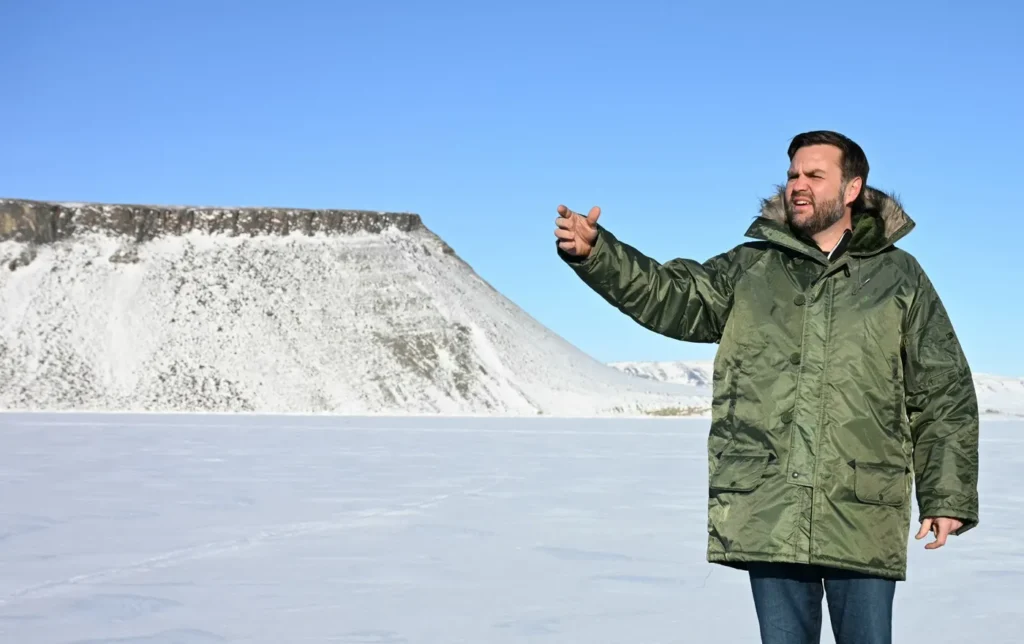
JD Vance wants Greenland in his grip.
Photographer: Jim Watson/AFP/Getty Images
President Donald Trump has stepped up his pressure campaign to make Greenland a part of the US. Arguing the national-security importance of fully controlling the vast island — an autonomous part of the Kingdom of Denmark — the administration has talked of buying it or even taking it by force. His latest slap is that Greenland’s defense is “two dog sleds” and its populace “does not want to see Russia or China take over.”
But are claims of Greenland being absolutely necessary for US security legitimate? Is purchasing it really an option? What would be the consequences of the US using the military to occupy the island?
Things are headed to a crisis. Vice President JD Vance and Secretary of State Marco Rubio are scheduled to speak with the foreign ministers of Denmark and Greenland at the White House on Wednesday.
Predictably, all of this has landed badly in Europe. The Danish prime minister, Mette Frederiksen, said that Danish law would not permit selling the territory, and Greenland’s prime minister, Jens-Frederik Nielsen, likewise rejected the idea out of hand.
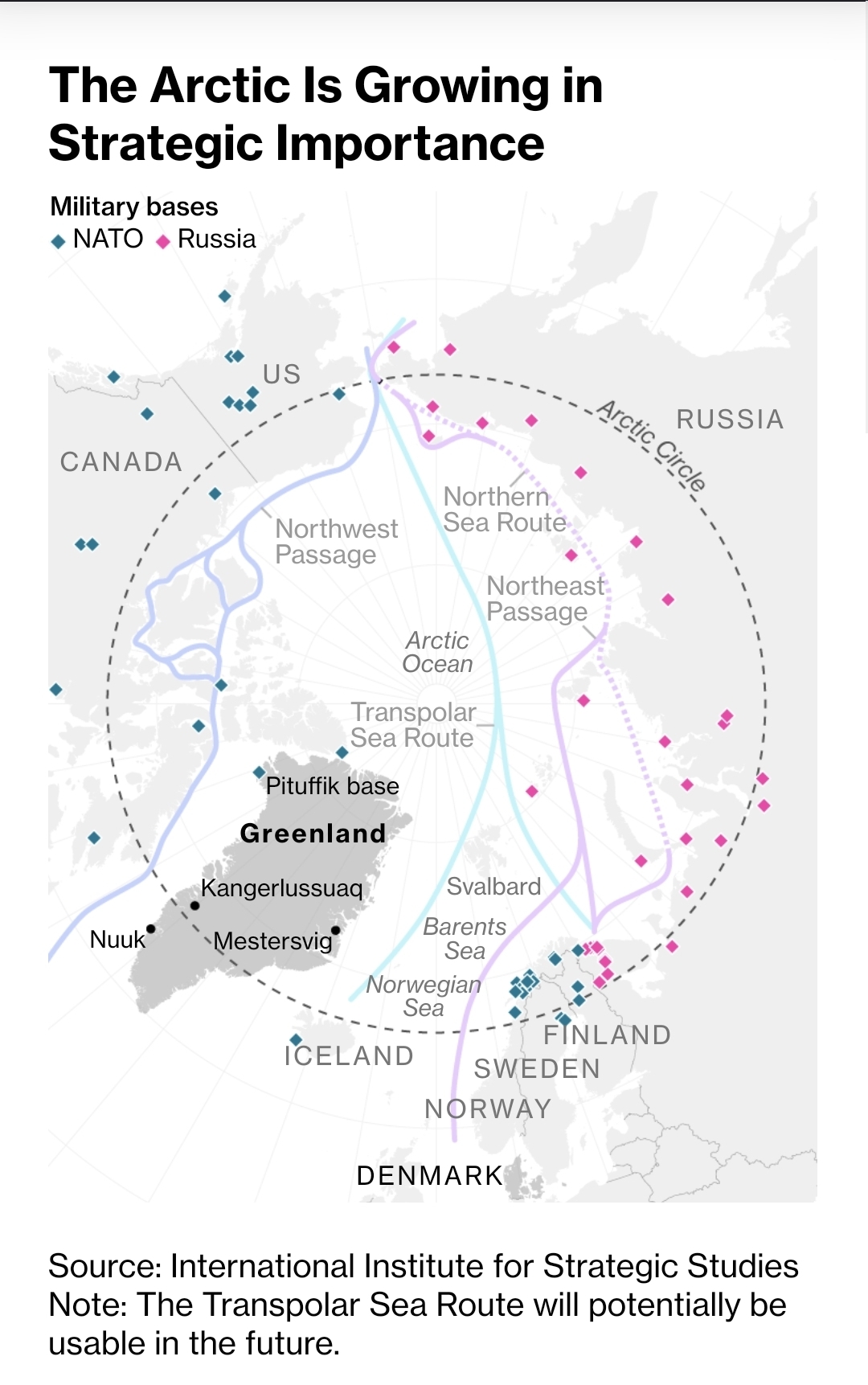
The Trump administration has touted the acquisition as vital for several reasons, including critical and strategic minerals; encroachment by China and Russia; a crucial geostrategic position astride the North Atlantic sea routes; and — above all — the growing importance of the Arctic.
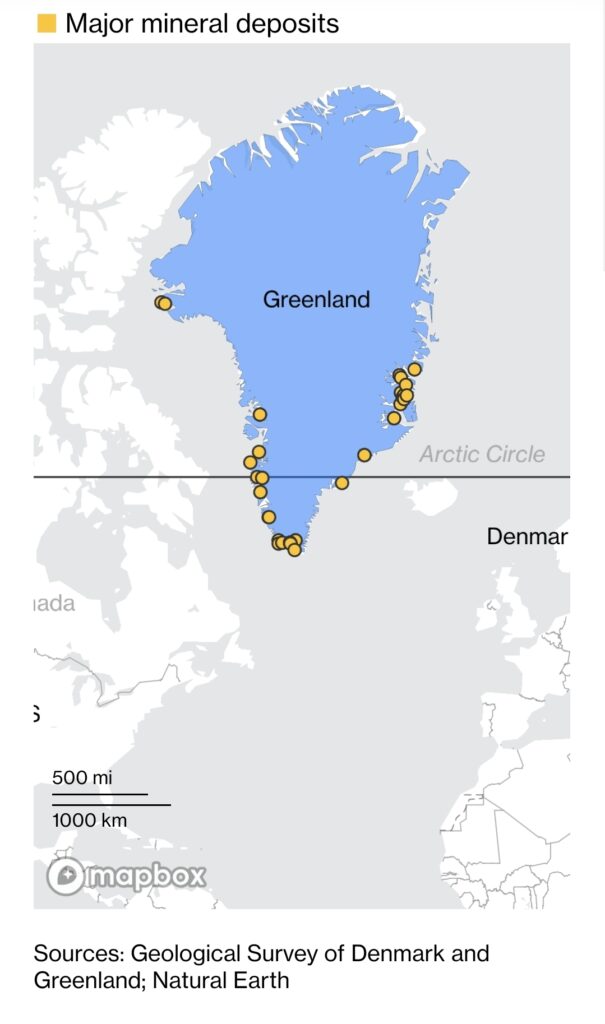
Let’s start with the commodities argument. My Bloomberg Opinion colleague Javier Blas lays out a convincing case that the potential mineral bonanza is exaggerated. While the island has significant mineral deposits, a 2023 Danish geological survey identified only around 50 locations with potential. And half are north of the Arctic Circle and therefore particularly difficult to tap.
Those in the southern reaches of the island don’t appear to be sufficiently large to make mining them commercially feasible, at least at current prices. It would be easier to mine in the US (which has larger deposits than Greenland), Brazil, Chile, Peru, the Democratic Republic of Congo, Vietnam and a handful of other known locations.
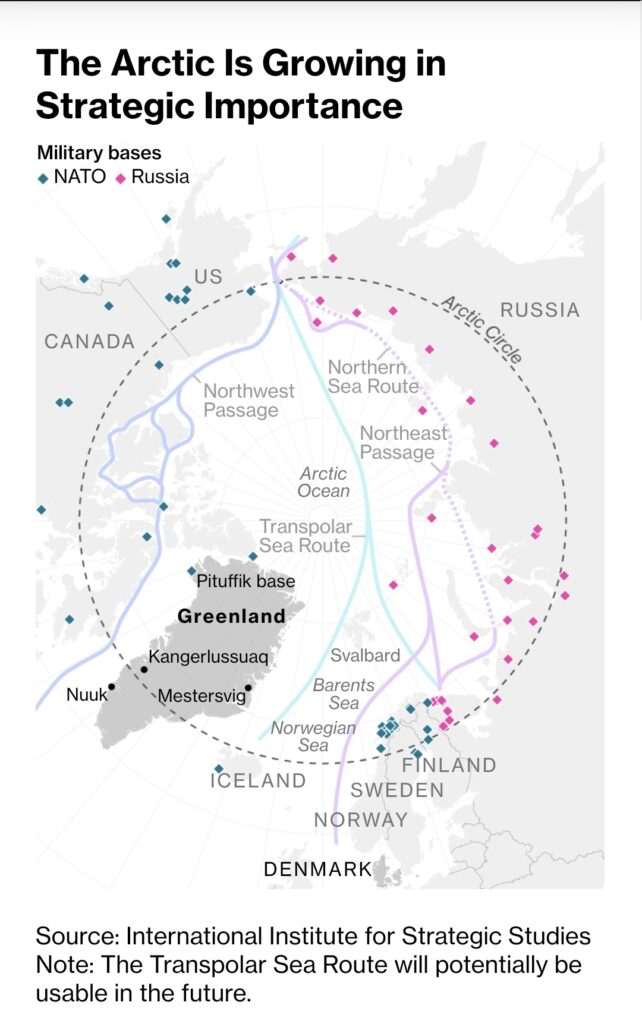
Intrusion by China and Russia — both militarily with their warships and commercially with economic engagement — is a stronger reason for concern. But since Greenland is sovereign territory of a North Atlantic Treaty Organization ally, the US already has a built-in security partner. The Pentagon’s Space Force has a base on the island, and the Danes and the Greenlanders are open to hosting more US aircraft, warships and troops — but only within the NATO framework.
When I was NATO’s military commander just over a decade ago, I visited both the Danish Parliament in Copenhagen and Greenland itself. I received many offers to increase cooperation and bring more US assets onto the island — “the door is always open,” the Danish prime minister at the time, Helle Thorning-Schmidt, told me. NATO Secretary General Anders Fogh Rasmussen, my boss, was a former Danish prime minister and always interested in expanding the alliance’s role across the North Atlantic. Yes, we need to counter China and Russia — but this is well within the grasp of the US under the current arrangemen
As for the sea routes, the island is a vital link in the chain across the top of the North Atlantic. This passage, called the Greenland-Iceland-UK Gap, is the route Russia would use to flood the Atlantic with naval forces. Of particular concern are Moscow’s quiet, capable nuclear-attack and ballistic-missile submarines that are increasingly difficult to monitor. Perhaps more worrisome is the new Poseidon nuclear-powered underwater system, a kind of “super torpedo” that can supposedly travel more than 6,000 nautical miles, move at super-high speed when submerged, and carry nuclear weapons.
Many Western analysists are skeptical of these claims. Nonetheless, the Russians are putting time and money into underwater warfare; keeping them at bay would be easier with anti-submarine bases linking Greenland to other US and NATO military installations.
Finally, there is the importance of the Arctic. Greenland’s crucial geographic position is hard to overstate. As global warming melts the ice caps, the competition for shipping routes and natural resources will heat up. Russia, with its immense coastline, dominates one side of the Arctic Ocean. On the other side are arrayed seven NATO Arctic nations: the US, Canada, Denmark (via Greenland), Iceland, Norway and the two recent additions, Sweden and Finland. China is building a formidable fleet of icebreakers and considers itself, oddly, an Arctic nation. Having full sovereign control of Greenland would undeniably help the US in its ambitions for the High North.
But here’s the problem: It’s not just the Danes and Greenlanders who oppose a full-scale US acquisition — so do the rest of the European members of NATO. Some are considering strong diplomatic and economic measures should the US act forcefully, including possible sanctions on American goods and services, or even an armed mission under an EU flag. The Europeans understand that the path to security in the north lies with standing together as allies, not allowing Trump to basically destroy NATO.
The idea of buying the island, however, is worth pursuing. There is precedent: The US purchased the Danish West Indies (now US Virgin Islands) in 1917, and seriously discussed buying Greenland after both the Civil War and World War II. But if the Danes and Greenlanders refuse to sell, as looks almost certain, Washington could tighten cooperation through a more binding agreement known as a Compact of Free Association — along the lines of what the US has with the Marshall Islands in the Pacific.
Full US control of Greenland is geostrategically appealing. But so often in life, how you do something is more important than what you are doing. Washington needs to build greater security in the Arctic and North Atlantic — but not through a military action that would shatter the NATO alliance.
_____________________________