Core takeaways
U.S. policymakers often find themselves blindsided by conflict-related crises. Those involved frequently lament afterward that officials should have done more to avert or prepare for these crises.
“The world continues to grow more violent and disorderly,” says conflict prevention expert Paul B. Stares.
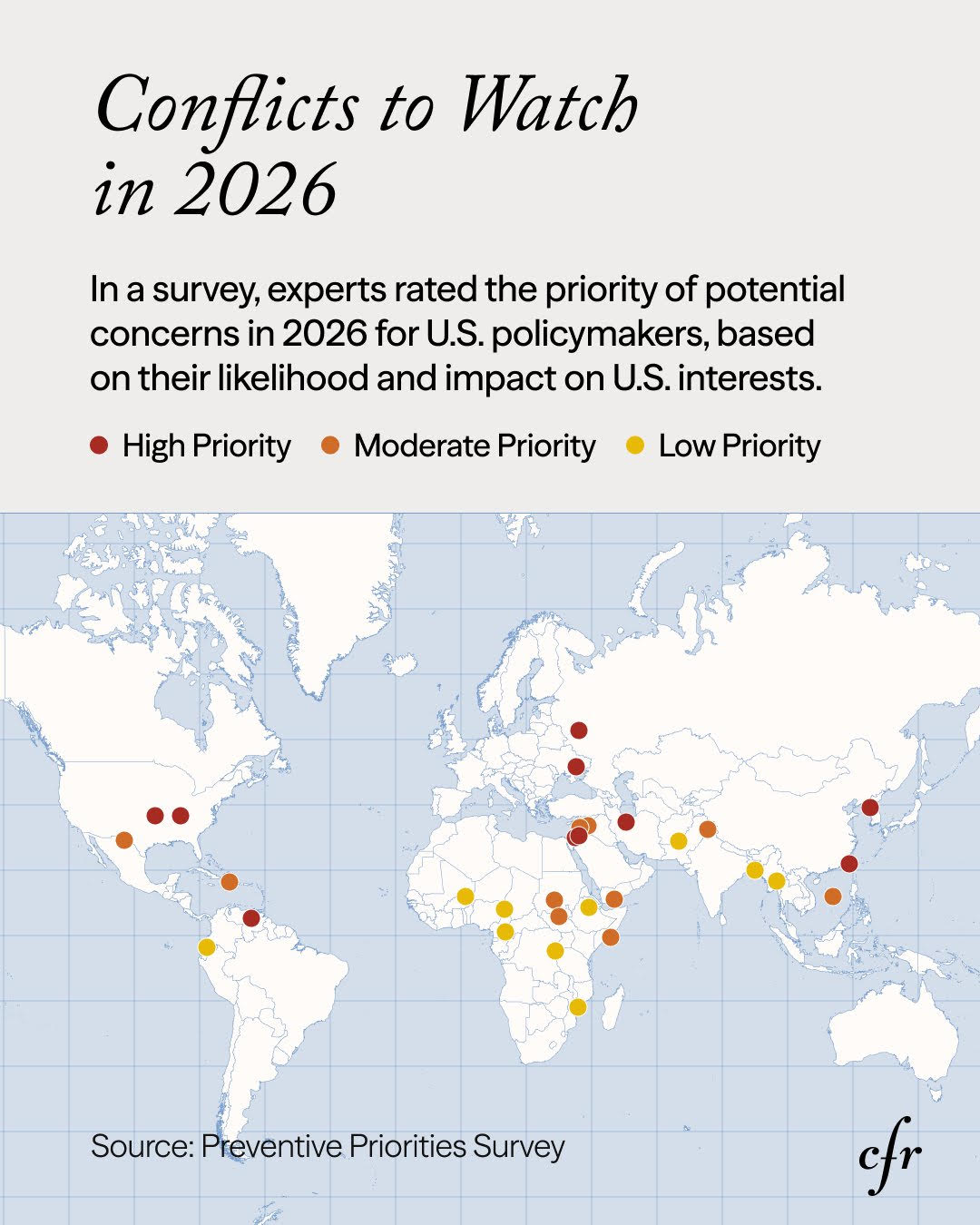
His survey of over 600 U.S. foreign policy experts rates the top concerns for 2026: https://www.cfr.org/report/conflicts-watch-2026?utm_campaign=pps-2026&utm_medium=social_owned&utm_source=tw
Overview
The world continues to grow more violent and disorderly.
According to CFR’s annual conflict risk assessment, American foreign policy experts are acutely concerned about conflict-related threats to U.S. national security and international stability that are likely to emerge or intensify in 2026. In this report, surveyed experts rate global conflicts by their likelihood and potential harm to U.S. interests and, for the first time, identify opportunities for preventive action.
About the Preventive Priorities Survey
For the past eighteen years, the Center for Preventive Action (CPA) has surveyed American foreign policy experts to assess the risk posed to U.S. national interests by ongoing and emerging sources of armed conflict around the world.
The logic of this exercise is straightforward: U.S. policymakers often find themselves blindsided by conflict-related crises that divert attention and resources away from other priorities and even lead to major military interventions that cost American lives. Those involved frequently lament afterward that officials should have done more to avert or prepare for these crises. Thus, the purpose of the Preventive Priorities Survey (PPS) is not just to alert busy U.S. policymakers to incipient sources of instability over the next twelve months but also to help them decide which are most pressing.
The need for U.S. policymakers to look ahead and actively lessen conflict-related risks grows every year. The world has undeniably become more violent and disorderly. Indeed, the number of armed conflicts is now at its highest since the end of World War II. An increasing proportion of those, moreover, are interstate conflicts, reversing a post–Cold War trend. The United States is uniquely exposed to the growing risk of armed conflict, as no other power has as many allies and security commitments.
The second Trump administration has sought to end many ongoing conflicts, such as those in the Democratic Republic of Congo, the Gaza Strip, and Ukraine, as well as between India and Pakistan and Cambodia and Thailand. At the same time, however, it has engaged in unnecessarily destabilizing behavior, specifically threatening force and other coercive measures against several countries, including allies, notably in the Western Hemisphere. Regrettably, it has also systematically dismantled the very elements of the U.S. government dedicated to strategic foresight, conflict prevention, and peace-building without replacing them with anything better. Related funding has been slashed in the process. Those actions are both counterproductive and shortsighted.
U.S. policymakers often find themselves blindsided by conflict-related crises. Those involved frequently lament afterward that officials should have done more to avert or prepare for these crises.
1. Top Conflicts to Watch in 2026
Source:
Center for Preventive Action (CPA)
The Center for Preventive Action (CPA) aims to help policymakers devise timely and practical strategies to prevent and mitigate armed conflict around the world, especially in places that pose the greatest risk to U.S. interests.
CPA accomplishes this by commissioning in-depth reports, convening meetings of experts, and consulting with representatives of governments, international organizations, civil society groups, corporations, and the media. The center’s Global Conflict Tracker informs the general public about threats to international peace and security by providing a reliable and regularly updated online source of information about ongoing conflicts.
Preventive Priorities Survey 2026