Core takeaway
But something of the highest importance is at stake here. And perhaps it is not too late to advance a view that, I believe, is not only mine alone but is shared by a number of others with extensive and in most instances more recent experience in Russian matters. The view, bluntly stated, is that expanding NATO would be the most fateful error of American policy in the entire post-cold-war era.
Such a decision may be expected to inflame the nationalistic, anti-Western and militaristic tendencies in Russian opinion; to have an adverse effect on the development of Russian democracy; to restore the atmosphere of the cold war to East-West relations, and to impel Russian foreign policy in directions decidedly not to our liking. And, last but not least, it might make it much more difficult, if not impossible, to secure the Russian Duma’s ratification of the Start II agreement and to achieve further reductions of nuclear weaponry.
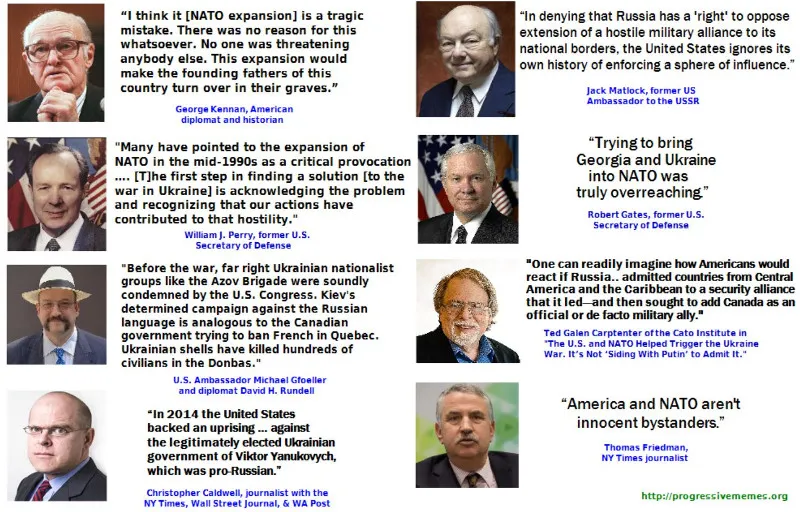
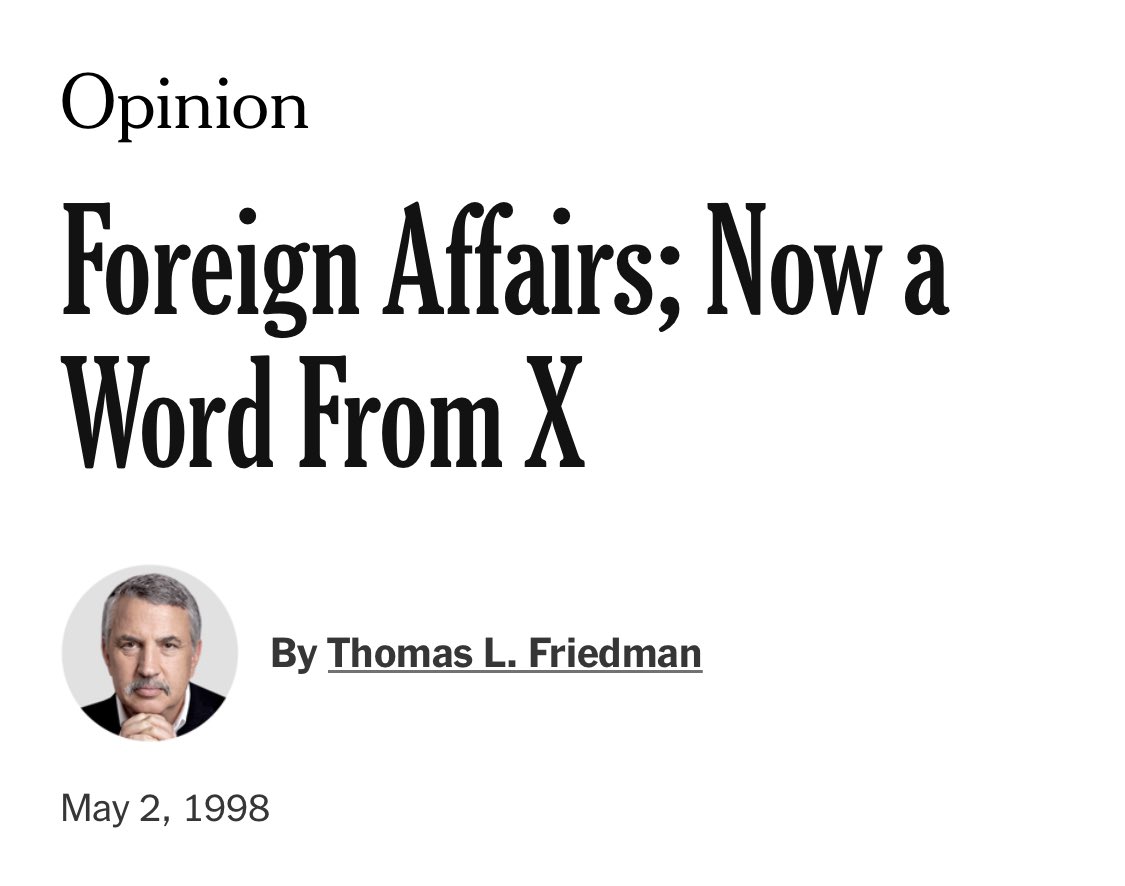
George Kennan on NATO expansion (May 2, 1998):
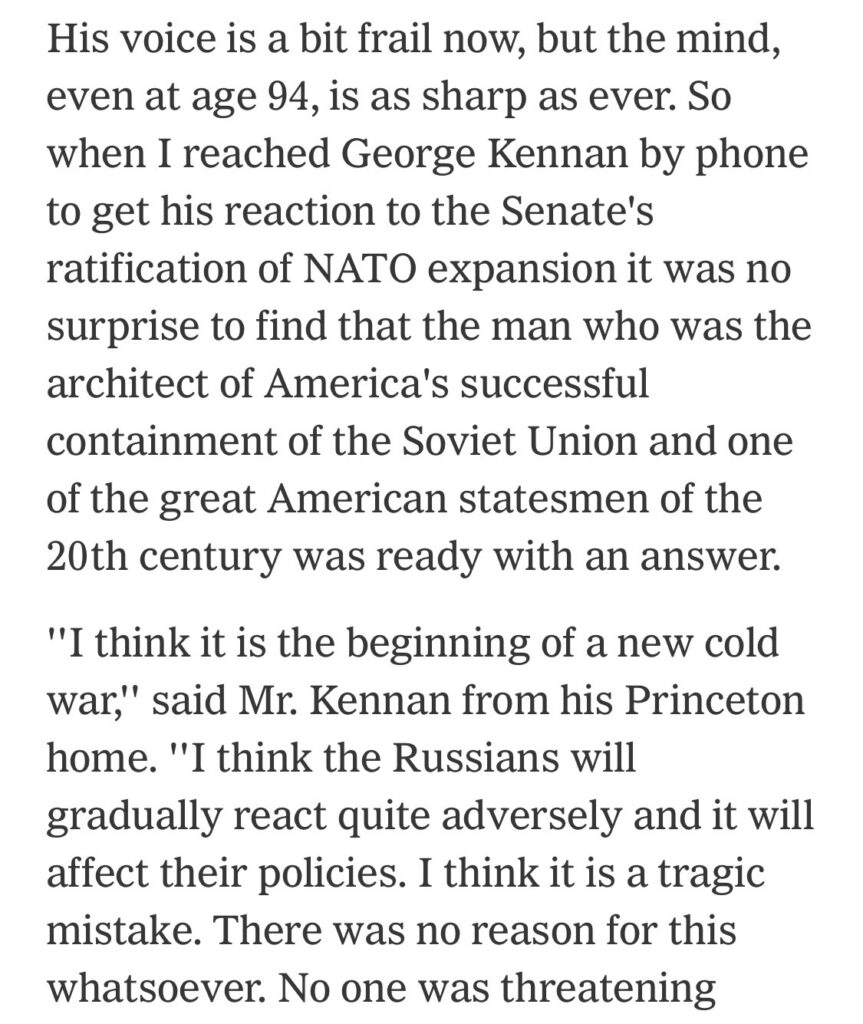
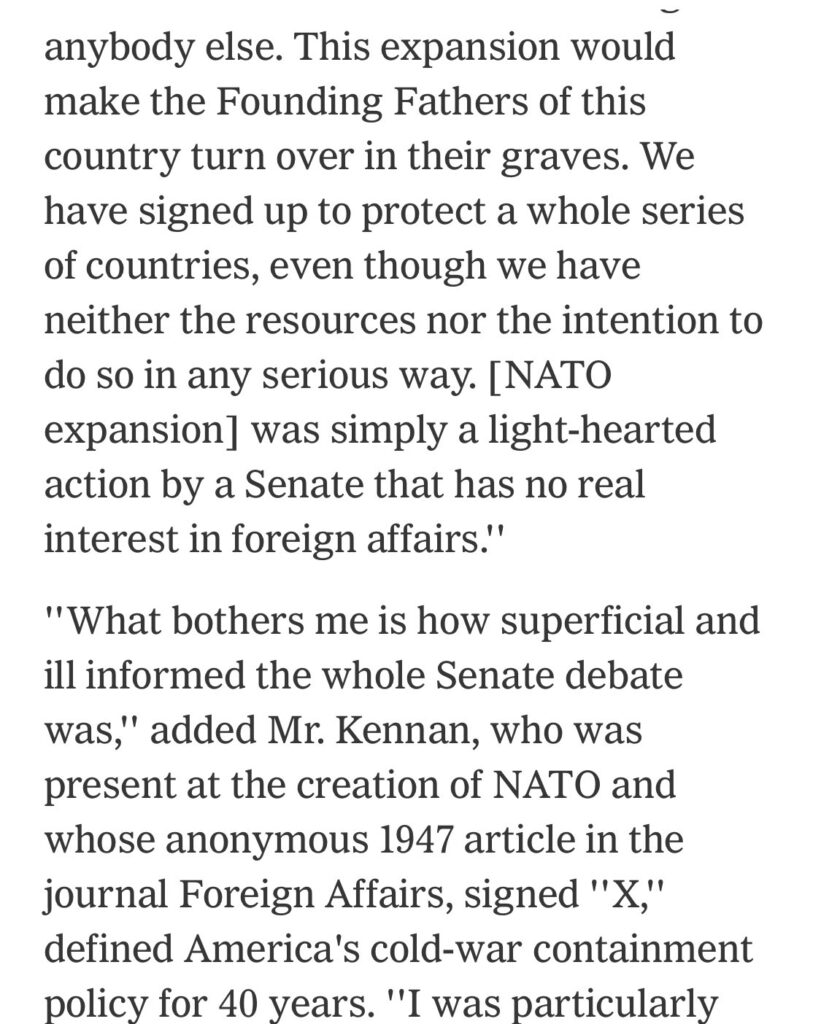
– ”I think it is the beginning of a new cold war,” said Mr. Kennan from his Princeton home. ”I think the Russians will gradually react quite adversely and it will affect their policies. I think it is a tragic mistake. There was no reason for this whatsoever. No one was threatening anybody else. This expansion would make the Founding Fathers of this country turn over in their graves. We have signed up to protect a whole series of countries, even though we have neither the resources nor the intention to do so in any serious way. [NATO expansion] was simply a light-hearted action by a Senate that has no real interest in foreign affairs… Of course there is going to be a bad reaction from Russia, and then [the NATO expanders] will say that we always told you that is how the Russians are — but this is just wrong.3. https://x.com/i/status/2013936048309424522
____________________________
1. https://www.nytimes.com/1997/02/05/opinion/a-fateful-error.html?smid=nytcore-android-share
But something of the highest importance is at stake here. And perhaps it is not too late to advance a view that, I believe, is not only mine alone but is shared by a number of others with extensive and in most instances more recent experience in Russian matters. The view, bluntly stated, is that expanding NATO would be the most fateful error of American policy in the entire post-cold-war era.
Such a decision may be expected to inflame the nationalistic, anti-Western and militaristic tendencies in Russian opinion; to have an adverse effect on the development of Russian democracy; to restore the atmosphere of the cold war to East-West relations, and to impel Russian foreign policy in directions decidedly not to our liking. And, last but not least, it might make it much more difficult, if not impossible, to secure the Russian Duma’s ratification of the Start II agreement and to achieve further reductions of nuclear weaponry.
But there is one thing future historians will surely remark upon, and that is the utter poverty of imagination that characterized U.S. foreign policy in the late 1990’s. They will note that one of the seminal events of this century took place between 1989 and 1992 — the collapse of the Soviet Empire, which had the capability, imperial intentions and ideology to truly threaten the entire free world. Thanks to Western resolve and the courage of Russian democrats, that Soviet Empire collapsed without a shot, spawning a democratic Russia, setting free the former Soviet republics and leading to unprecedented arms control agreements with the U.S.
And what was America’s response? It was to expand the NATO cold-war alliance against Russia and bring it closer to Russia’s borders.
Yes, tell your children, and your children’s children, that you lived in the age of Bill Clinton and William Cohen, the age of Madeleine Albright and Sandy Berger, the age of Trent Lott and Joe Lieberman, and you too were present at the creation of the post-cold-war order, when these foreign policy Titans put their heads together and produced . . . a mouse.
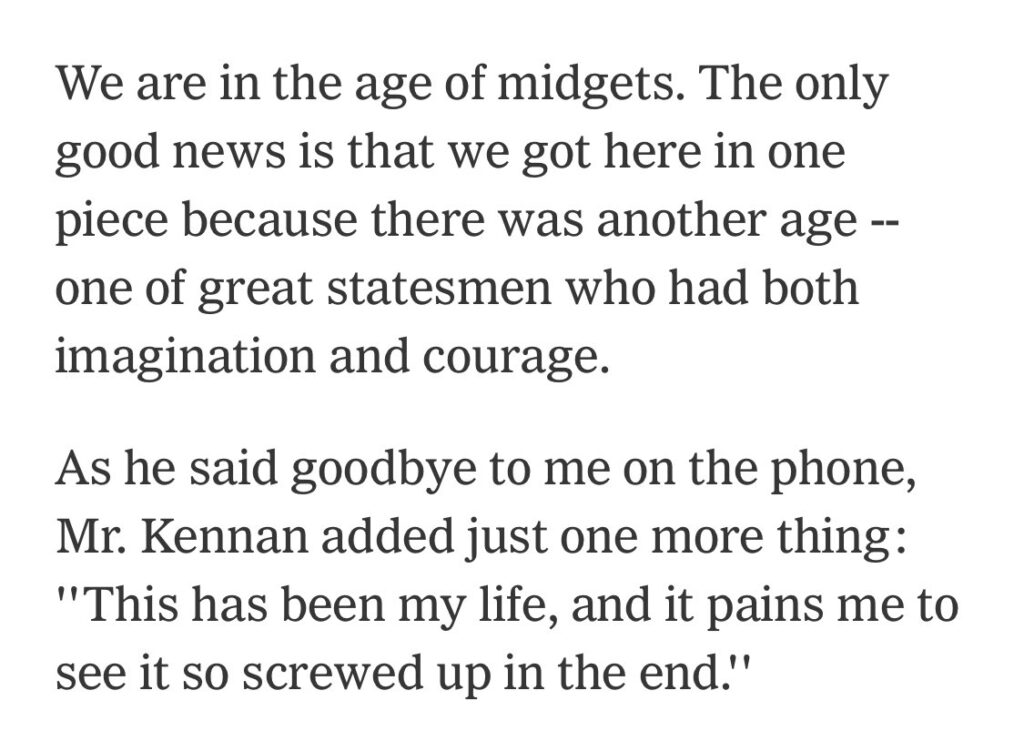
We are in the age of midgets. The only good news is that we got here in one piece because there was another age — one of great statesmen who had both imagination and courage.
As he said goodbye to me on the phone, Mr. Kennan added just one more thing: ”This has been my life, and it pains me to see it so screwed up in the end.”