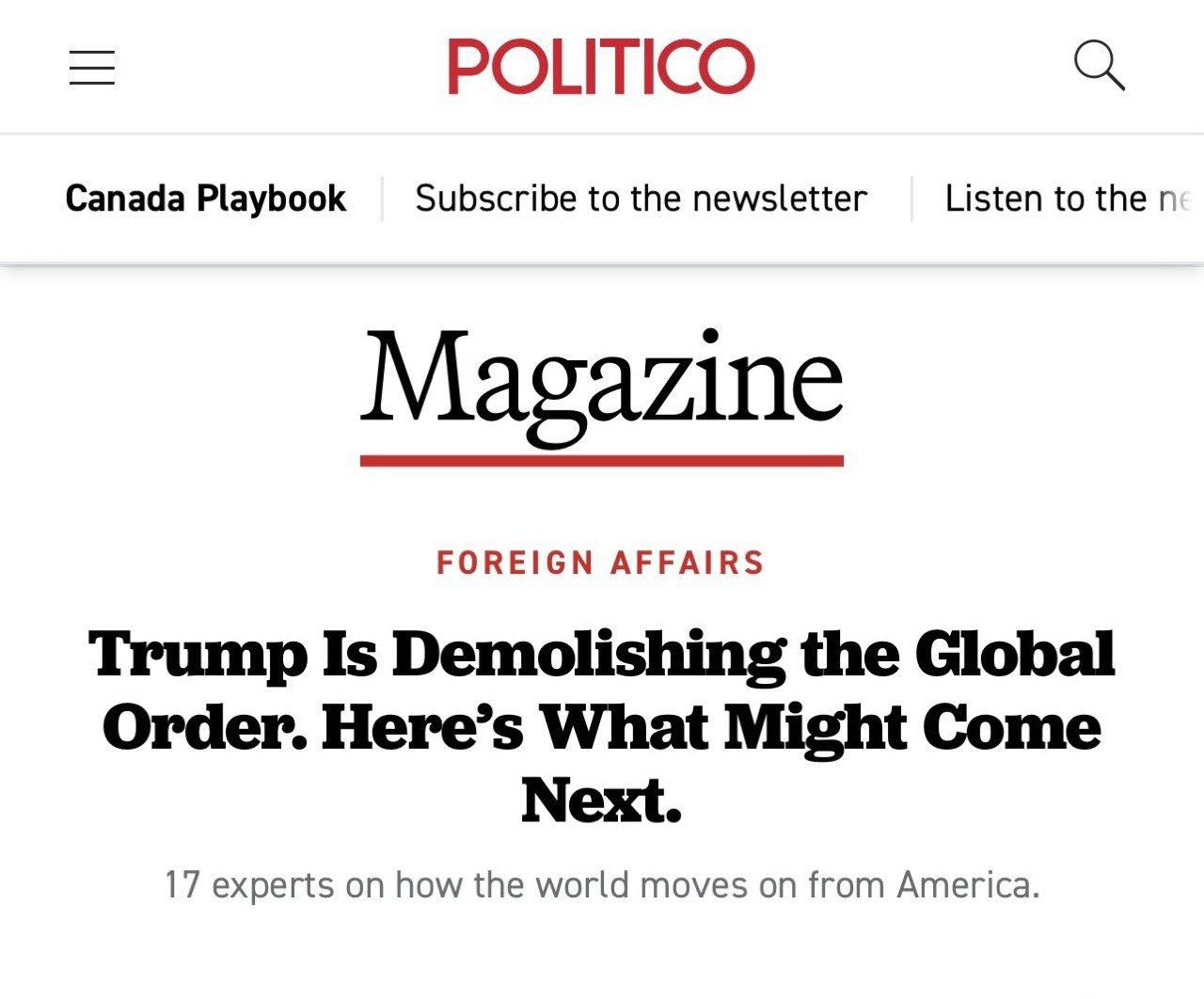
POLITICO has published a thought-provoking piece:
“Trump Is Demolishing the Global Order. Here’s What Might Come Next. 17 experts on how the world moves on from America.”
Here are the key takeaways and conclusions.
I’d love to hear your thoughts on this¹.
The United States has dismantled the postwar order.
Even close allies started to see Washington in a new light after public threats to “take” Greenland.
While a formal de-escalation followed, the signal was clear: the U.S. has entered a new competition over geographic spheres of influence, with military and economic pressure becoming normalized tools of foreign policy.
Trust among allies has been shaken. NATO security guarantees are no longer seen as unconditional – particularly by Europe and many other “middle powers” around the world.
POLITICO raises a core question for middle powers: what should they do right now?
The general answer: both cooperation and realism are required. Unity among middle powers will never be complete – it must be assembled pragmatically, task by task, quickly and flexibly.
First key conclusion: coalitions should become the primary organizational form for middle powers.
Not as one grand, all-encompassing bloc, but as flexible coalitions of the “willing and capable,” built around specific tasks: maritime security, sanctions enforcement, export controls, critical minerals, cyber defense, technology standards, and energy resilience.
In an era of divide et impera, the main risk for middle powers is isolation and being pushed into bilateral deals under pressure. The solution lies in networks of practical alliances that can move faster than large institutions and provide collective weight where individual states lack it.
Second conclusion: anti-coercion resilience is essential.
This includes diversifying trade and supply chains, reducing dependence on critical chokepoints and resources, encouraging mutual investment among partners, and developing the ability to quickly replace bottlenecks in production and infrastructure.
This is insurance against blackmail. The lower the vulnerability to economic pressure, the greater the political space for principled positions and maneuver – and the lower the risk of being pulled into someone else’s sphere of influence as an object rather than a subject.
Third conclusion: controlled resistance is needed.
Coercion and violations must not be normalized – but neither should middle powers rush into confrontations they are bound to lose due to asymmetric resources.
What works here is a combination of firmness and diplomacy: responses must be strong enough to alter the other side’s calculations, yet controlled enough to leave room for de-escalation.
This is especially relevant when “spheres of influence” are advanced not by tanks, but by ultimatums, tariffs, technology bans, or demonstrative shows of force.
For Europe, the main lesson remains unchanged: move from reaction and outrage to capability-building.
Strategic autonomy – in security, the economy, and energy – is no longer a nice concept; it is a survival manual. This is not about symbolic projects on paper, but about closing concrete gaps: intelligence and surveillance, command and control, strategic logistics, ammunition and stockpiles, air and missile defense, industrial capacity, and the ability to sustain high-tempo defense production over time.
In a world of spheres of influence, rules only matter where there is power to enforce them – and Europe must be able to do so even with reduced U.S. involvement.
For the EU, there is also an institutional dimension. If consensus among all 27 members slows decisions, a system of “variable geometry” is needed within the Union: a core group able to move faster on defense procurement, industrial policy, critical infrastructure protection, sanctions coordination, and countermeasures against economic coercion.
In a world of spheres of influence, the speed of decision-making is often no less important than the decisions themselves.
Finally, Europe must not only build muscle – it must find its voice.
Today, the EU often sounds like a regulator and a donor, but not enough like a strategic actor capable of defining interests, naming threats, setting priorities, and offering others a coherent framework for cooperation.
A “voice” is not rhetoric. It is the combination of three things: a clear political line, the capacity to back it with resources (security, economic, and technological), and consistency in action.
If Europe learns to speak plainly and firmly about what it stands for, where its “red lines” are, and what it is prepared to do to uphold them, its position will begin to sound credible.
This is how the EU can move from being an object of great-power bargaining to becoming a full-fledged global actor – one that does not merely react to new spheres of influence, but helps shape the rules and the coalitions.
Source:
https://www.politico.com/news/magazine/2026/01/27/post-nato-middle-powers-expert-roundup-007485491.