Core takeaways
John Mearsheimer: There’s NO DECISIVE WIN for TRUMP w/IRAN
¹ On 29 January 2026, I was on the “Deep Dive” with Lt. Col. (ret.) Danny Davis. We had an excellent discussion on what President Trump’s options are in a war against Iran.
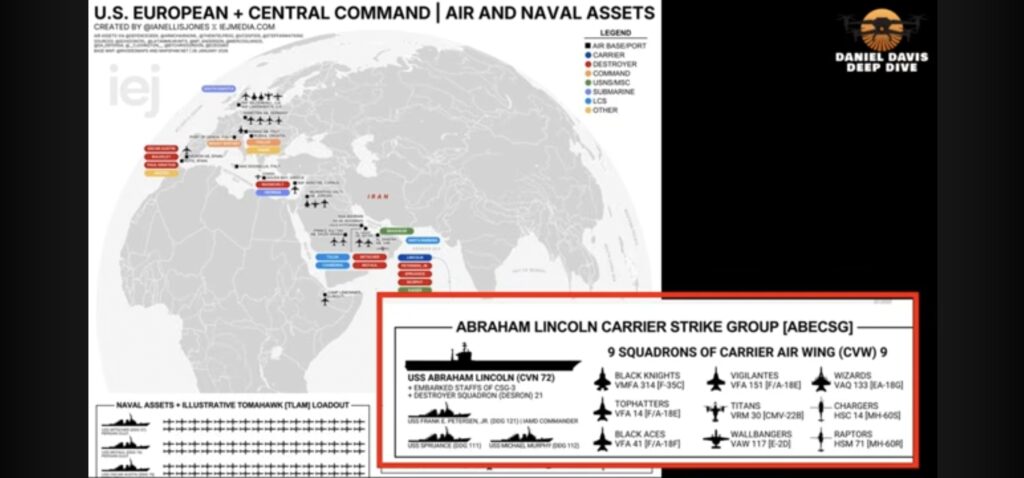
We both agreed that he has no good military option at this point or for the foreseeable future, which is not to say Trump will not attack.
But all the evidence indicates that he would be foolish to do so.
Indeed, it is quite clear that the Israelis, who asked him not to attack on January 14th, when he appeared ready to do so, still have reservations about the wisdom of an attack.
Now he has helped maneuver Trump into contemplating a US-only war against Iran, although it appears that the Israelis are getting cold feet. Someone is being played for a sucker.
Below is the segment of the show dealing with a possible attack on Iran.
It is worth noting that the Israelis launched major attacks by themselves against Iran on 19 April 2024 and 26 October 2024.
They then launched major attacks with the United States against Iran during the 12-day war in June 2025. Today, Israel is apparently planning to sit on the sidelines while the US attacks Iran by itself.
What is going on?
Netanyahu tried hard to drag the Biden administration into attacking Iran with Israel in 2024, but failed. Biden and his lieutenants understood that a war with Iran was not in the American national interest.
Netanyahu succeeded, however, in getting Trump to join forces with Israel and attack Iran in June 2025.
² Daniel Davis Deep Dive
John Mearsheimer: There’s NO DECISIVE WIN for TRUMP w/IRAN
John Mearsheimer argues that Israel and the United States previously stopped a war with Iran (the 12-day war) because they realized they could not defend themselves effectively. Israel was overwhelmed by Iranian ballistic missiles, and the U.S. burned through about 25% of its THAAD missile stockpile—an unsustainable risk to U.S. national security. Israel’s defensive position today is no better, which explains why any potential new attack on Iran would be carried out by the U.S. alone, with Israel trying to stay on the sidelines to avoid retaliation.
The same constraints that halted a planned January 14 strike still exist: U.S. generals say a decisive victory is impossible, Netanyahu does not want a war, and Iran has clearly warned that any U.S. attack will trigger full retaliation—against Israel, U.S. bases in the region, and by closing the Strait of Hormuz.
Trump is described as having boxed himself in rhetorically. Having issued ultimatums Iran cannot accept (ending enrichment, missile programs, and regional influence—core survival interests), he feels pressure to act. The likely outcome, the speaker suggests, is a limited, symbolic strike followed by a declared “victory.” But this is extremely dangerous because Iran has signaled it would respond massively even to limited attacks.
The broader claim is that U.S. policy is driven largely by Israeli goals: regime change and the fragmentation of Iran, not just nuclear limits.
From Iran’s perspective, this makes the threat existential, explaining its hair-trigger posture and large missile arsenal.
The speaker concludes that Iran’s restraint—especially not acquiring nuclear weapons—has been strategically foolish, since nuclear deterrence (as with North Korea) would likely prevent U.S. and Israeli attacks altogether.